
Decatur Projected Versus Actual Release
A projected date estimates when custody may end after applying the sentence, Kansas law, available credit, and release authority. KASPER calls its public field the Earliest Possible Release Date. The word “possible” matters. Good-time changes, program credit, a new court action, a detainer, sentence aggregation, or a parole decision may move it.
An actual county release is the physical exit recorded by the Decatur Sheriff. A court order may authorize that exit before jail staff finish processing. For a state prisoner, a KASPER status or movement change and the formal KDOC record are stronger evidence than the earlier projection. A VINE timestamp reflects notification processing, not a state-prison release record.
Find Decatur Projected Release Dates
Start with the system that holds the person. The Decatur County Sheriff handles an ordinary county booking. The District Court holds bond, journal entry, sentence, and jail-credit context. KASPER applies only when KDOC operates or funds the custody or supervision stage.
- Confirm whether the person is in county jail, a KDOC facility, federal custody, or another system.
- For KDOC, open the KASPER gateway and match the KDOC number or full identity.
- Read the current status, locations, movements, sentence data, and Earliest Possible Release Date together.
- For a county sentence, obtain the court journal entry and jail-credit information, then ask the sheriff for the actual release entry.
- Direct a KDOC calculation question to the Sentence Computation Unit at 785-296-3317.
A no-result does not prove release. The person may never have entered KDOC, a name may differ, the record may fall outside coverage, or a lawful removal may apply. KASPER updates on working days, so recent admission and movement data can lag.
KASPER Decatur Release Date Fields
KDOC’s locating information says KASPER covers incarcerated, supervised, and discharged offenders in covered programs since 1980. Search fields include name, aliases, KDOC number, State ID or KBI number, race, gender, birth date or age range, conviction county, parole-supervision county, and photo options. An SSN can serve as a match field, but it should not be published or shared needlessly.
| Field | Meaning | Limit |
|---|---|---|
| Current status | Custody, supervision, or discharge stage | May update on the next working day |
| Earliest Possible Release Date | Current KDOC projection | Not the completed event |
| Movements and locations | Facility or supervision changes | A transfer is not community release |
| Sentence data | Conviction and term context | Complex terms require official computation |
The official KASPER source is shown below. Its warning and field context should travel with any projected date.
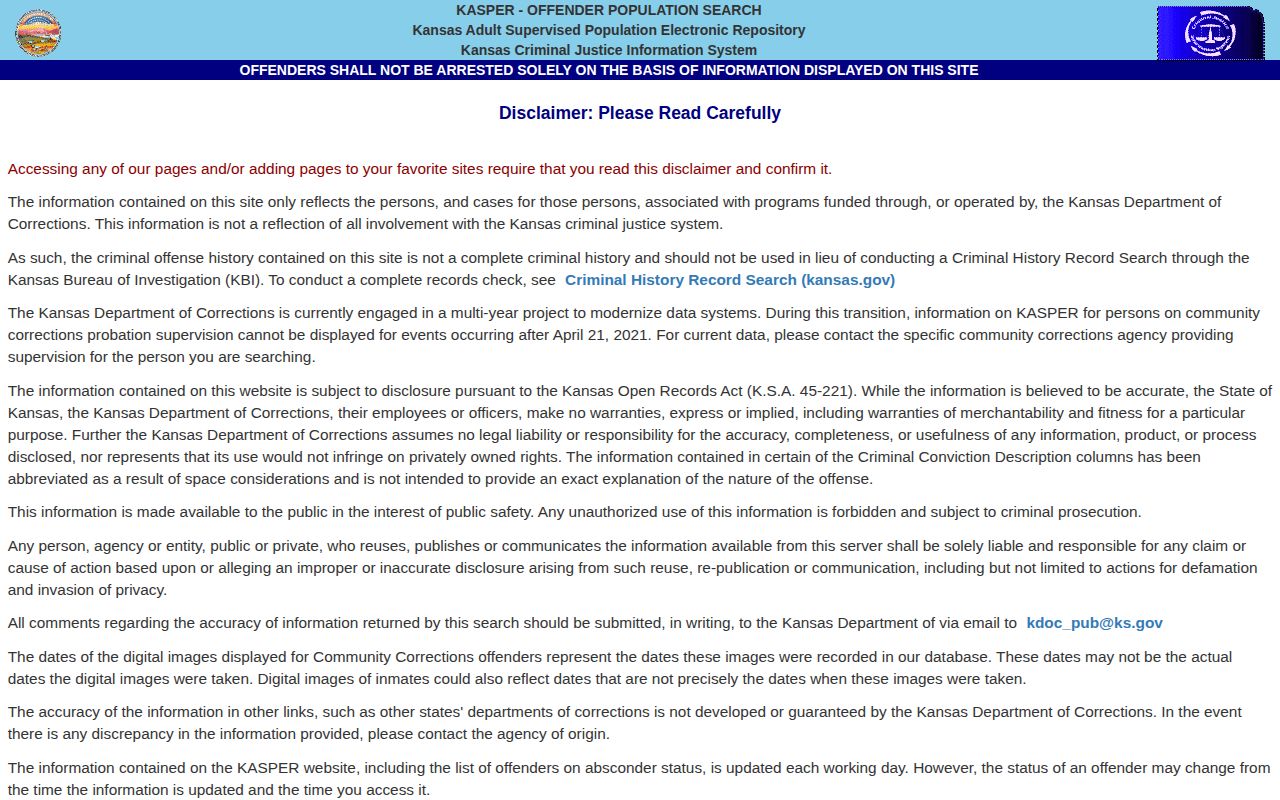
KASPER is the correct state-prison channel, not a substitute for the Decatur Sheriff’s county release record.
Decatur Release Credit Rules
K.S.A. 21-6821 authorizes good-time credit for determinate sentences. “Determinate” means the court imposed a set prison term rather than an older minimum-to-maximum term. For many crimes committed on or after July 1, 1993, the maximum credit is 15 percent of the prison part. That rule produced the common “85 percent” shorthand.
The shorthand is not universal. Specified lower-severity nondrug and drug offenses in defined date groups can receive up to 20 percent. Eligible program credit can add up to 120 days. Some sexual-offense provisions apply credit to supervision in a different way. Good time must be earned and can be withheld or forfeited for discipline. Program credit depends on completion and statutory eligibility.
Older indeterminate sentences follow another framework. The KDOC glossary describes good time of up to 50 percent in that setting, but parole eligibility also depends on the sentence minimum, offense law, credit, and Prisoner Review Board action. Life, off-grid, and special murder terms have distinct rules.
Why 85 Percent Misleads Decatur
Kansas’s 85-percent phrase describes the common 15-percent-credit determinate category. It is not a safe calculator for a named Decatur County case. A person may fall within a 20-percent category, qualify for program credit, have an older indeterminate term, or serve a sentence with special rules. Even the correct percentage does not disclose whether all credit was earned or retained.
Never subtract a flat percentage from the announced sentence. The court’s sentence may include concurrent terms, which run at the same time, or consecutive terms, which run one after another. Jail credit, resentencing, sentence aggregation, and detainers also matter. KASPER’s current Earliest Possible Release Date incorporates the agency’s computation more reliably than home arithmetic.
Questions about how KDOC calculated the field belong with the Sentence Computation Unit at 785-296-3317. Apparent errors in other public KASPER data go to kdoc_pub@ks.gov. These are separate correction paths.
Changes to Decatur Release Projections
A projected release date changes when the facts or legal rules used in the computation change. Each adjustment should be traced to an agency record instead of guessed from a calendar.
| Change | Possible effect | Best source |
|---|---|---|
| Good-time loss or restoration | Moves the possible date | KDOC sentence computation |
| Eligible program credit | May reduce the prison part | KDOC record and statute |
| Resentencing or corrected journal entry | Changes the underlying term | Court file |
| Concurrent or consecutive terms | Changes aggregation | Court and KDOC computation |
| Detainer or transfer | May prevent community release | Holding and receiving agencies |
| Board action | Affects eligible indeterminate cases | Prisoner Review Board and KASPER |
A detainer is another authority’s request to hold a person or receive notice before release. It can mean the person leaves one agency yet enters another. “Released from Decatur County custody and transferred” is more accurate than “free” when the sheriff names a receiving authority.
Decatur County Sentence Dates
A pretrial Decatur detainee often has no calculated release date. Bond, dismissal, and other court orders can change custody, while the jail records the physical release time. For a person serving a county sentence, ask the District Court for the journal entry and jail-credit information. Then ask the sheriff for the actual entry and release disposition.
Decatur County publishes no local jail good-time rule, weekend-release policy, or online projected-date calculator. No local arithmetic should be invented. The lack of an online roster also means a disappearance from a copied third-party list is not evidence of release. Call the sheriff at 785-475-8100 for present county custody and request the record when written proof is required.
- Jail credit
- Time a court credits toward a sentence for eligible prior confinement.
- Detainer
- A hold or notice request from another authority.
- Projected date
- An estimate based on the present computation.
- Actual release
- The completed custody event recorded by the responsible agency.
Confirm Decatur Actual Release
For county custody, the sheriff release timestamp is primary. Compare it with the District Court order to learn the legal reason. For state prison, read the KDOC status and movement or obtain the formal discharge record. The Decatur probation and parole page explains how supervision may continue after the prison phase.
Kansas VINE is limited to county-jail notification and does not cover KDOC state prisoners. A county VINE alert should still be checked with the sheriff. For a federal prisoner, use the BOP locator. For present immigration detention, use ICE’s locator. Each date belongs to its source and event. When two dates differ, explain that distinction rather than choosing one.
Decatur Parole Date Limits
A Prisoner Review Board calendar is another date that should not be collapsed into a release projection. Public-comment sessions occur before the hearing and possible eligibility month. Placement on a monthly list does not mean parole was granted. A “continue” outcome delays a decision, while a “pass” denies parole and sets a later hearing period. Only “parole” reflects a grant, and the later custody record still must show the move.
K.S.A. 22-3717 governs parole eligibility and postrelease through detailed offense and date rules. Eligible older indeterminate cases can reach Board consideration after the minimum term as adjusted by applicable credit. Determinate guidelines cases commonly move to postrelease when the prison portion ends instead of receiving discretionary parole in the older sense.
The county of conviction on a Board list is not a release destination. A Decatur County entry can identify where the case began without showing where the person will return. Check the assigned KDOC office and updated KASPER record after any Board action.
Request Decatur Computation Records
When public fields do not answer the question, request the source record. For KDOC, use the official KORA instructions and GovQA portal. Identify the person by full name and KDOC number, conviction county or case, and approximate date. Ask for the public sentence-computation, release, or discharge material that explains the field.
GovQA supports tracking, agency correspondence, notices, and downloads. Kansas law permits reasonable actual costs and advance payment. Ask for an estimate. K.S.A. 45-221 allows some correctional material to be withheld while identifying public categories that include sentence information, parole eligibility, custody or supervision level, and certain location and releasee information. A public projected date does not open every part of the file.
For Decatur County jail data, direct the request to the sheriff. Ask for the booking and release time, disposition or destination, case number, and relevant county sentence information. The sheriff publishes no special form, fee table, retention promise, or computation policy, so phrase the request around the actual fields needed.
Public Record Search
Sponsored Results