
Decatur Probation and Parole Compared
Probation, parole, and postrelease supervision are not interchangeable. Decatur County District Court may place a person on probation and route the case through court services or community corrections. The Kansas Prisoner Review Board grants parole in eligible older, indeterminate cases. Many people serving determinate Kansas sentences move to postrelease supervision when the prison part ends. Their public corrections record may use terms such as supervised, postrelease, parole, conditional release, or discharged.
The agency matters because each record proves something different. A court docket can show a probation order and later action in the case. KASPER can show KDOC custody, supervision, office, movements, and discharge data. It does not cover every county-only probation event, and it is not the source for an ordinary Decatur County Jail release.
| Type | Source | What to verify |
|---|---|---|
| Probation | Decatur District Court and court services | Order, term, later violation, modification, or discharge |
| Parole | Prisoner Review Board and KASPER | Board action, current status, supervision office |
| Postrelease | KDOC and KASPER | Release from prison phase, supervision level, discharge |
- Parole
- Conditional community supervision after release under a parole decision.
- Probation
- Court-ordered supervision that may replace or follow confinement.
- Discharge
- The recorded end of a custody or supervision term.
- Absconder
- A person reported as failing to remain in contact as required; the label does not prove present jail custody.
Check Decatur Post-Release Supervision
Begin with the last known authority. If the person was released from Decatur County Jail on a local case, request the sheriff release entry and inspect the Decatur County District Court docket. If the sheriff says the person transferred to KDOC, use KASPER. A transfer ends county custody but is not a release to the community.
- Match the full name, birth data, case number, or KDOC number before relying on a result.
- Check the court case for a probation order, revocation, discharge, or commitment to KDOC.
- Search KASPER for current status, supervision level, movement history, and assigned office when KDOC was involved.
- Contact the office shown in the source record to confirm the proper public channel for current information.
- Use the originating court, KDOC, or sheriff record when a date or status conflicts.
KASPER updates on working days, so a new event may not appear at once. It also omits community-corrections probation events after April 21, 2021 while modernization work continues. A no-result can mean the person was never in KDOC, the search identifiers are wrong, the event falls outside coverage, or a record was removed under law. It cannot be converted into “off supervision.”
Decatur Parole Office Route
Decatur County has no standalone KDOC parole storefront in the official state chart. The documented route is Northwest Kansas Community Corrections, North in Hays. The office serves Decatur and other northwest counties. This regional route is especially useful when KASPER cannot display a newer community-corrections event.
Northwest Kansas Community Corrections, North117 E. 13th Street
Hays, KS
785-625-9192
Call to identify the correct public contact, not to assume that every Decatur probation file is held there. Court-services probation and KDOC supervision can follow distinct administrative paths. For a local probation order, the District Court record remains the durable starting point. The court page also identifies the 17th Judicial District court-services contacts.
The official Decatur court page shows the local court and probation route. The image below helps distinguish that court source from a KDOC supervision result.
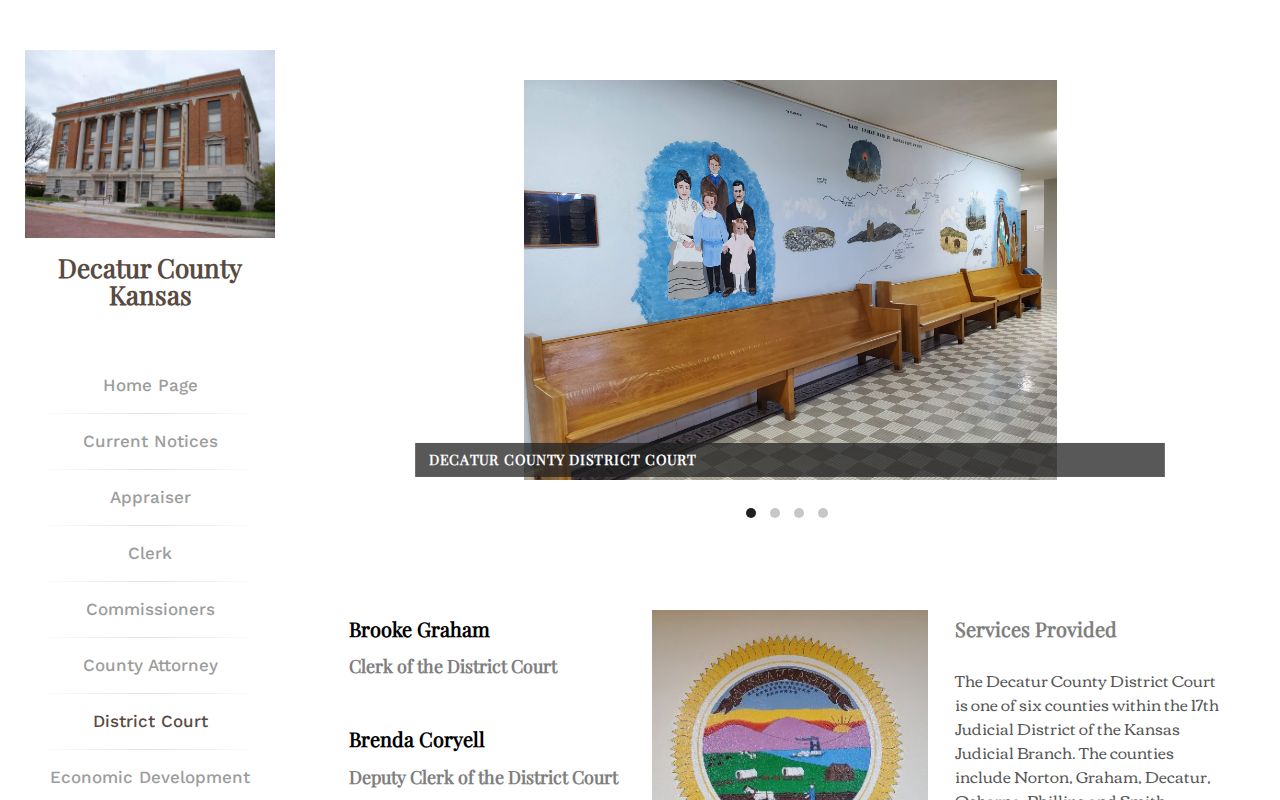
The court record explains the order. The supervision office handles the assigned community process.
Decatur Supervision Absconder Checks
KASPER publishes two separate searches: a parole absconder search and a community-corrections absconder search. They are not one broad warrant list. Search the channel that matches the supervision type, confirm identity, and read the label in context.
An absconder entry reports a supervision problem. It does not establish that the person has been arrested again or booked into Decatur County Jail. Working-day updates can lag. For present county custody, contact the Decatur Sheriff. For the status of the supervision case, use the assigned agency and its record.
The official community-corrections absconder page is shown here as the distinct probation-side channel.
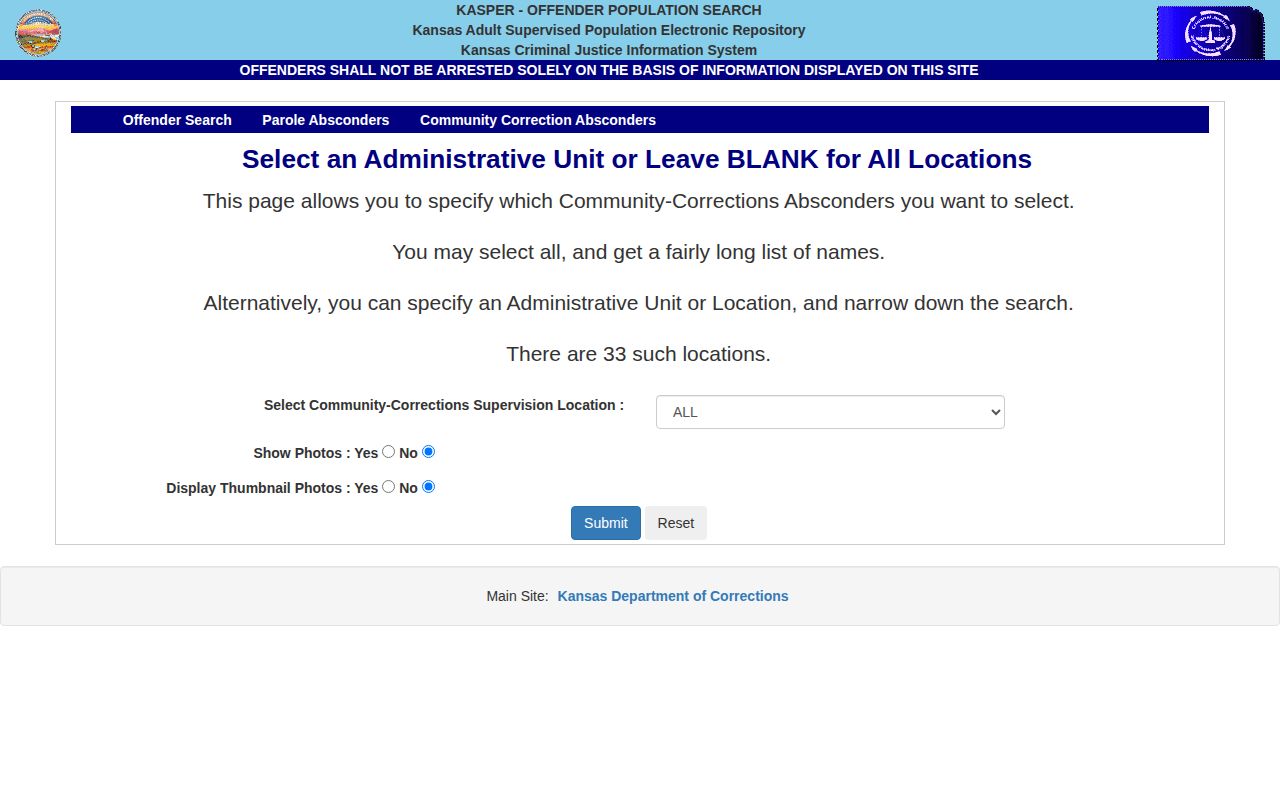
Do not read absence from this list as proof of compliance or discharge.
Decatur Parole Hearing Records
The Kansas Prisoner Review Board listed-offender page is a lead, not a release list. Public-comment sessions generally occur about a month before the hearing and potential eligibility month. A Decatur County conviction on the list shows a case connection. The Board warns that the county of conviction need not be the person’s home or return county.
Board outcomes also require exact terms. “Parole” means the Board granted parole subject to the process and conditions. “Continue” delays a decision for more information, votes, or review. “Pass” denies parole and sets a later hearing period. No official person-level public decisions database was found. After the hearing, inspect KASPER for an updated status and request the written action from KDOC or the Board when needed.
K.S.A. 22-3717 contains offense and date-specific eligibility rules. A hearing month is not an actual release date.
Correct Decatur Supervision Records
Kansas separates public-data correction from sentence computation. Send an apparent KASPER public-data error to kdoc_pub@ks.gov. A name, movement, status, or other displayed data problem belongs on that route. Supply enough identifiers and describe the field at issue without sending needless private data.
Questions about a calculated date go instead to the KDOC Sentence Computation Unit at 785-296-3317. A projected date can reflect jail credit, concurrent or consecutive terms, good-time credit, program credit, resentencing, detainers, and administrative corrections. Keeping these contacts separate avoids turning a date question into a general web-record correction.
Decatur Post-Release Resources
The 2024 Decatur County resource list supplies a local navigation layer after release. It lists Heartland RADAC for assessment and referral, a Thursday Narcotics Anonymous meeting, Kansas Legal Services, High Plains Mental Health, and the Decatur County Food Pantry. These services do not prove parole, probation, or eligibility for aid. Contact each provider to confirm its current hours, intake process, and service area.
A supervision officer may give directions that differ from a general resource list. Follow the actual order and assigned agency instructions. The list is most useful for finding a place to ask about legal aid, behavioral health, substance-use support, or food access without treating any listing as a guaranteed appointment.
Decatur Supervision and Discharge
Supervision ends through an official discharge, not through silence in a search. The District Court docket may record completion or discharge from probation. KASPER may retain a durable KDOC record with a discharged status. For state corrections, compare current status, movement history, supervision fields, and the responsible office rather than relying on a single projected date.
A violation can lead to a court or agency response, but it does not automatically prove reincarceration. Revocation means the authority withdrew the community status after due process. A detainer is a request by another authority to hold or notify about a person. If either appears, identify which agency issued it. The Decatur County released inmate search explains how the sheriff release record and court case establish the underlying physical exit.
Release from supervision can occur later than release from a jail or prison. Keep those events separate. The jail entry answers when county custody ended. A KDOC movement can mark the end of the prison phase. A later court or KDOC discharge answers when the supervision obligation ended. When records use more than one date, label each source and event instead of selecting the earliest date.
Decatur Release Supervision Conditions
Conditions are the rules attached to probation, parole, or postrelease supervision. The exact order controls. Public record terms may address reporting, travel, court-ordered payments, contact restrictions, or participation in a directed program, but no condition should be assumed from the supervision label alone. Obtain the court order or public KDOC condition record that applies to the named case.
If an alleged violation appears, check for the next official action. A filed allegation, an absconder entry, a court warrant, a revocation order, and a new jail booking describe distinct stages. The absconder pages report a supervision status and may lag. The court docket can show a hearing or ruling. Only the sheriff can confirm a new Decatur County booking. Matching those records prevents a reported supervision issue from being overstated as present custody.
K.S.A. 45-221(29) treats some non-treatment supervision conditions and violation data as public within its correctional-record framework, while other material may be withheld. Ask the custodian to identify the legal basis for any redaction. Do not infer private treatment facts from a gap in the public record.
Public Record Search
Sponsored Results